Director: Nick Murphy
Genre: Supernatural Horror
Source: UK (2011)
Director: Nick Murphy
Genre: Supernatural Horror
Source: UK (2011)
Rating: R
Location/Format: Netflix Instant Streaming
Grade: B-
I'm not sure why I watch horror movies sometimes. I'm really a big scaredy-cat. So I can't say I gave this film my full attention as I watched. Instead I did some housework and browsed reddit on my iPad, so I will admit to not fully engaging myself in the movie, and that's on me.
But I still was pleasantly surprised. Led by a trio of strong British actors (Rebecca Hall, Dominic West, Imelda Staunton), the film treads over territory you may have seen before, most notably conjuring movies like The Others (one of my favorite ghost movies) or Shutter Island, wherein things aren't all that they seem. But that's not a knock. There's still plenty of creepy imagery, atmosphere, and jump scares to make it pretty solid. The dollhouse, for example, is not a fresh idea, but it still works well here. A little bad CG for one major effect gets in the way, but not enough to undercut my enjoyment overall.
And stylistically, I really thought the film stood out. The cinematography provides an appropriate tone for the film even before creepy things start to happen. Set in 1921, the film is full of shadow and desaturated colors, and even the sunlight feels cold. The costumes and the school/house that provides the setting of the movie also work well to create a bleak and somewhat disturbing atmosphere. Hall in particular thrives here, as she begins to question her own beliefs and sanity as the film goes on. Given the world she's wandering through however, it's not particularly surprising. If I were in her place I might start to believe that there really are things that go bump in the night as well.
Overall the film works, and it was not a bad way to spend an afternoon. Definitely afternoon, though. Evening or night and I think I might have had to pay even less attention so as not to be too frightened. As mentioned, I am a bit of a pansy.
Alternate Film Title: "Creepiest Rabbit Head Doll Ever"
 Director: Guillaume CanetGenre: ThrillerSource: France (2006)
Rating: R
Location/Format: Netflix Instant Streaming
Grade: A-
The phrase "Hitchcockian" is probably thrown around too much when discussing thrillers, and while Tell No One is a top-notch thriller with moments clearly indebted to the master, I would hesitate to call the film as a whole Hitchcockian. Canet is interested in the thrill and mystery of the story for sure, but he is more interested in the emotional forces inspiring the story rather than the psychology (which always strikes me as Hitch's focus). The film works in large part because Canet allows the film to slow down and explore the passion and pathos of the journey, rather than just the mental twists.
Francois Cluzet, as Alexandre Beck, is definitely an everyman protagonist. Though a successful doctor, he is also charmingly regular, both in his appearance and in his life. The murder of his wife early in the film breaks his heart (unless it doesn't) and eight years later he has put his life back together but still finds himself shadowed by her death. When he receives a strange email, he begins to suspect that not all is what it seems, and his pursuit of the truth drives him from friends to enemies to friends who might be enemies.
The film's pace is at times leisurely, but punctuated by intense moments of action, such as Alexandre's mad flee from the police, or an attempted kidnapping later in the film. Canet uses sound brilliantly throughout, both in creative music choices (often with plot or thematic significance) and in his decision during some key moments not to use music, but to simply let the diegetic sound create the tension of the scene. It works, and I found myself drawn in even more than I imagine I would have by the traditional thumping Hollywood soundtrack. That run from the police is a great example, again. As Alexandre runs, he doesn't shout or yell, he doesn't have an invasive score telling us to be tense--he simply runs, looking behind as the police draw ever closer, keeping his focus on trying to escape. It's incredibly effective, and it reminded me of Hitchcock's innovative use of sound (and here I said I wasn't going to make those comparisons).
The film is taut without being absurd, energetic while still taking the time to delve into the emotional implications of its story. At its heart it is really a love story, and that focus allows the story to be more than just a standard thriller.
Alternate Film Title: "Pressure Points Are More Dangerous Than You Thought"
 Director: Larry CharlesGenre: Comedy, supposedlySource: USA (2012)
Rating: R
Location/Format: Netflix Instant Streaming
Grade: F
It's really strange to see Ben Kingsley absolutely dominate in something like Sexy Beast just a few days ago and then watch this. I guess everybody needs a paycheck now and then.
Apparently the magic of Ali G and Borat cannot strike every time, because this movie was terrible. While I laughed a few times (mostly at Jason Mantzoukas), nearly every line in this film was offensive and dumb. Offensive I can forgive and see the satiric reason for. Dumb is just dumb.
I could break this down a lot more into why it didn't work, why it's preachiness was redundant and ineffective, why Anna Faris should not be hired ever again, but I don't have the energy to do so. The 83 minutes I spent watching this movie is about 82 minutes longer than I should have spent on it.
Alternate Film Title: "Charlie Chaplin Did It So Much Better"
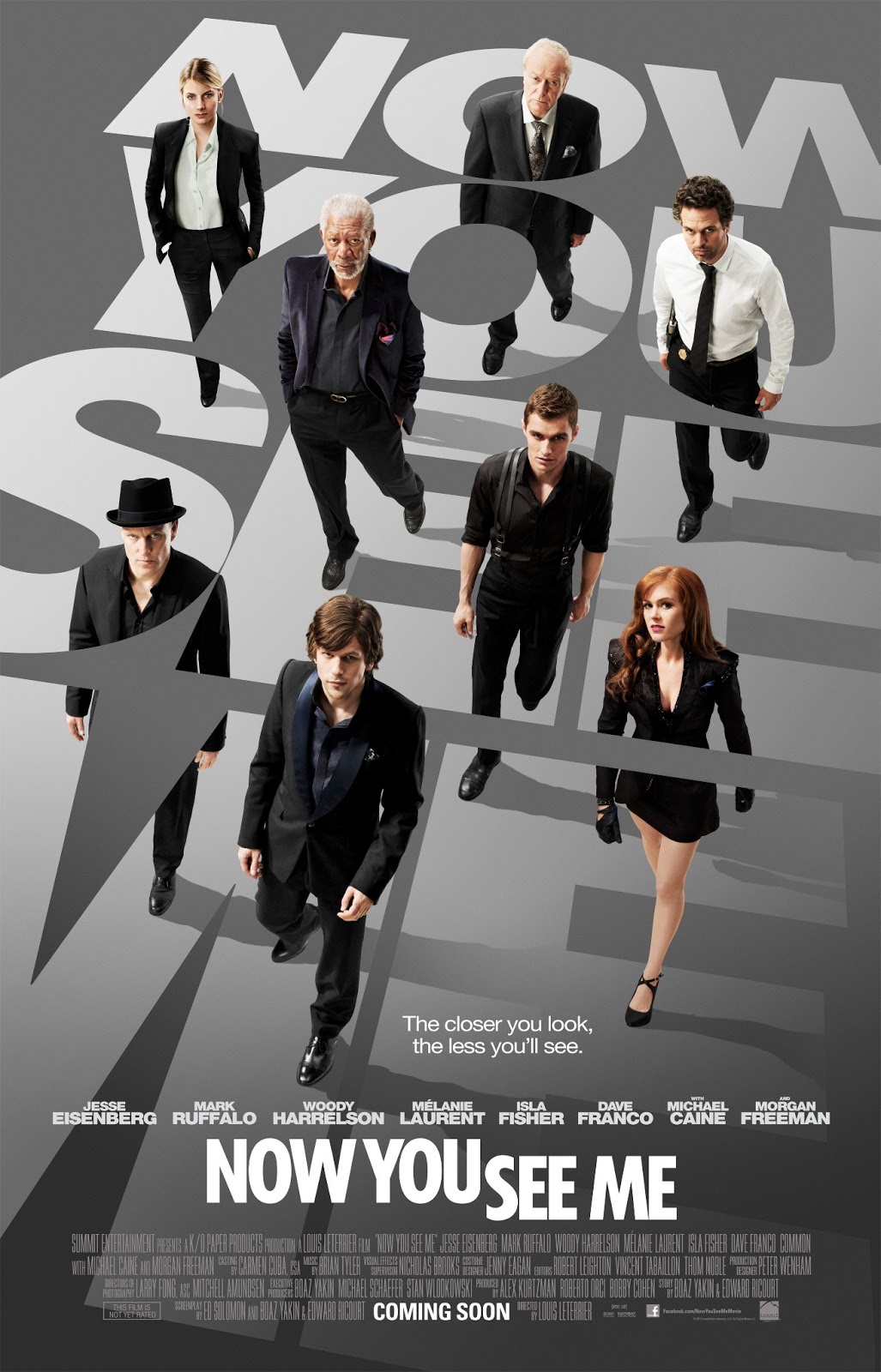
 Director: Louis Leterrier
Genre: Heist Thriller
Source: USA (2013)
Director: Louis Leterrier
Genre: Heist Thriller
Source: USA (2013)
Rating: PG-13
Location/Format: Glynn Place Stadium Cinema
Grade: D+
Maybe not all the time, but a lot of the time, the thing about a good heist film is that you feel like you're watching a magic trick. As the pieces of a plan come together--typically a plan that we in the audience only think we know--we see something bigger happening. We've been misdirected by the details, and the real "trick" is something much larger, cleverer, or just different than we originally thought. Inside Man, The Usual Suspects, Oceans Eleven--they dupe us into thinking we know what's going on, and the pleasure comes when we realize we don't.
Now You See Me fails at this. The heist and the tricks are not nearly as clever as the film seems to think they are, and though we see the plan happen, we don't get the pleasure of seeing the pieces come together, because we're never given enough information to be clear what's happening or why we should care. The payoff at the end is ultimately pointless--or at least we don't get to see what makes it matter. And though there are lots of actors I enjoy here (though Isla Fisher is kind of terrible), we don't get to see them really come together as a team--even though the whole point seems to be that they come together as a team. We see them meet and not like each other, and then see them some time later operating as a team, but we don't get the fun of building rapport and rivalry and tension and all that kind of stuff. It doesn't help that the "banter" they share (if it can be called that) takes place mostly on stage and either by design or due to terrible script-writing feels absolutely hollow, insincere, and scripted. This isn't Oceans Eleven by a long stretch.
The film also fails as a magic movie. Though there are a few slight of hand tricks that are fun to watch (the best still being Jesse Eisenberg's handcuff switcharoo from the trailer), most of the tricks feel empty because they are. They are digital effects, and even when they look ok, they are obviously not real. Compared to one of my favorite magic movies, The Prestige, the filmmakers here avoid any indication that magic is a skill or in any way hard. Even when that infinitely better Nolan film gets into the absurd and impossible, it's done such a fine job creating a world in which stage magic and illusion is a product of dedication and work that you buy the short step into the fantastic. Here it's all fantastic, but none of it feels real or earned.
I won't say I didn't enjoy some aspects of this movie, but I wouldn't recommend it. And I won't see it again.
Alternate Film Title: "Now You CGI Me"
 Director: Jim Sheridan
Genre: Drama
Source: UK (1989)
Director: Jim Sheridan
Genre: Drama
Source: UK (1989)
Rating: R
Location/Format: Netflix Streaming
Grade: A
Am I stating the obvious too much to suggest that Daniel Day-Lewis is the greatest actor working today? I know that's a bold statement, and usually I steer clear of absolutes like that, but every time I see a new performance, I lose the old Daniel Day Lewis and find a new person--physically, emotionally, mentally. Daniel Plainview. Abraham Lincoln. Hawkeye. Bill the Butcher. Christy Brown. He literally transforms himself, and though normally I find all that extreme acting business a little self-serious, self-indulgent, and silly, I can't deny that it seems to work for him. It did here. He's brilliant in My Left Foot as the cerebral palsy afflicted Irish painter in this biopic from 1989. He inhabits the role in a way that is both astonishing and heart-breaking but ultimately so honest that you can't help but feel guilty for pitying Christy. His intense desire not to be seen as an object of pity but as an emotional, intelligent, and three-dimensional figure--regardless of any physical shortcomings--drives the film forward. And credit where it's due: Hugh O'Conor as the young Christy is nearly as good as Day-Lewis, and he has to work with the added challenge of little to no dialogue.
Honestly pretty much everyone involved with the film seems to be working his or her butt off. Brenda Fricker plays Brown's mother with such compassion and composure that it's hard to know what to do with her--surely no one is that good all the time! Ray McAnally is strong as Brown's father, the stereotypical Irishman (though he's only mildly alcoholic) who struggles to express his feelings or his desperation to provide for his family, even as the children just keep coming.
Yet desperate is really the last word I should use to describe this family. As far as I know, this is Jim Sheridan's first movie. The director would go on to helm such strong films as In the Name of the Father (which I haven't seen), In America, The Boxer, and bizarrely 50 Cent's Get Rich or Die Trying. The films of his that I'm familiar with deal heavily in the angst, drama, and often tragedy of the working class Irish, yet in many ways this film defied my expectations. We see the challenges of Christy's life, without question, but more regularly we see the love that surrounds him in his mother, his siblings, and his father. We see that part of what allows him to thrive is the support system provided for him, even when there is no food, and no money, and apparently no hope. This is no Angela's Ashes, dwelling on the tragic Irish childhood. Christy is a neighborhood mascot first, but quickly becomes a neighborhood hero, and Sheridan allows that transformation from perceived idiot to brilliant artist to develop naturally and warmly. Warm browns inhabit the film--the colors of poverty yes, but also of home and hearth, and Sheridan always allows us to feel like part of the family, as tied to them as they are to each other.
At heart, that love is what this film is about--the love that fosters Christy's artistic potential, as well as the search for real romantic love regardless of his physical limitations. I wasn't sure exactly what to expect going in to this film, but I left with a sense of hope, of joy, and of appreciation for love of all types. My Left Foot is definitely one of the best films I've seen this year.
Alternate Film Title: None needed.
 Director: W.S. Van Dyke
Genre: Comedy Mystery
Source: USA (1936)
Director: W.S. Van Dyke
Genre: Comedy Mystery
Source: USA (1936)
Rating: Approved (probably PG)
Location/Format: DVD
Grade: B
Two Thin Men in to the Thin Man series, and I can see both the draw and the disappointments that the series might offer moving forward.
As with the original, the great fun of these movies are Powell and Loy. Their repartee and affection for one another are really entertaining, as good screwball comedy should be. As drink after drink and quip after often sexist quip go back and forth, I can't help what enjoy the chemistry between these two. They may not look like much of a match (Powell must be fifteen years older than Loy, and the years hit him harder) but their fondness for one another and apparent pleasure in one another's company really keeps the movie humming. And Asta continues to be delightful (though I feel like his subplot didn't go anywhere after a promising start, and yes that is a strange comment to make about a dog).
That said, the mystery here (as it was in the original) is actually a little more enjoyable than the original, but the way it followed the same outline counted against it. A young looking Jimmy Stewart makes a great appearance as a young man involved in the case, and there are some great high society barbs, but the plot points in the film (holiday party, lone investigation by Powell, and the "let's get all the suspects together in a room finale) seemed to follow the pattern of the original in a way that was a little uninspired. If it becomes the exact same sequence every time, I'm going to be disappointed.
But I'm still enjoying myself two movies in, and allowing time between films may keep that pleasure going. I'll be back for a third installment in a week or two, I'm sure.
Alternate Film Title: "Seriously, This Is What Alcoholism Looks Like"
So you take Professor Charles Xavier's School for the Gifted, you mix in a little World War II flavoring, a dash of generic YA lit, and a healthy sprinkling of gimmickry, bake it all together for 350 pages, and hope it tastes good, because you're really hoping you get a book series out of it.
I feel like that must have been the recipe Ransom Riggs (no way that's a real name) was following in creating this novel. Though the book has plenty of bits and pieces that I like as ideas, it leans far too heavily on the "found photographs" shtick, and when that loses energy and reveals itself to be a bit of an empty contrivance, the book doesn't quite follow through with enough story to really pull me in. Trying to fit in these pictures, which clearly are forced on the story in ways that work well at time and work poorly at times, just doesn't really take the book anywhere interesting. None of the characters really seem developed beyond the two-dimensional images we are presented with, and Riggs, in preparing the way for future books in the series, leaves off with an anti-climactic climax. Even Jacob seems like a relatively uninteresting character, his battle with psychological demons not particularly well drawn. When your first person narrator is, well, boring, with clear motivations but a bland interior life, I think there's a problem.
Good YA is hard to do well for me. It's really not my genre of choice. And Riggs isn't doing it badly because there are a lot of fun ideas here (the young X-men, the time travel element, etc.) even if a lot of it is recycled. But there's not a lot here that excites me either. Frankly, I'd rather go read more good X-Men comics, like those written by Joss Whedon or Chris Claremont. They knew how to blend the "peculiar" with real psychology in interesting ways. Riggs tries hard, but doesn't really pull it off for me.
Grade: D+

 Director: Nick Murphy